
Your high-performance Audi or BMW is a sophisticated network of proprietary software and precision engineering that most general shops simply cannot access. Choosing a standard mechanic for a specialized european car repair often leads to a frustrating cycle of "parts swapping" rather than true diagnostics. It's a common anxiety for Austin drivers. You expect precision, but you're often met with vague explanations and high dealership invoices. We believe you shouldn't have to choose between technical expertise and honest, local service.
You deserve dealership-quality work without the corporate markup or the lack of communication. Since 2017, we've seen how the brutal Central Texas heat degrades cooling systems and batteries much faster than the national average. This guide will show you how to maintain long-term reliability while navigating the 2026 regulatory landscape, including the abolition of safety inspections and the continued emissions requirements in Travis County. We'll outline how to find a specialist who uses factory-grade diagnostics to protect your investment. Discover why a system-wide approach is the only way to keep your vehicle performing at its peak on Texas roads.
Key Takeaways
- Understand why generic scanners fail to access proprietary European systems and why specialized diagnostics are essential for accurate troubleshooting.
- Learn how the extreme Austin heat accelerates wear on cooling systems and fluids, requiring a localized maintenance strategy for Central Texas.
- Discover how to secure dealership-quality european car repair without the traditional markup by choosing an independent specialist focused on transparency.
- Navigate the 2026 Texas regulatory changes, including the end of mandatory safety inspections and the continued importance of annual emissions testing.
- Identify the specific performance benefits of using OEM-spec parts and specialized fluids to maintain the tight mechanical tolerances of your vehicle.
Understanding the Precision of European Automotive Engineering
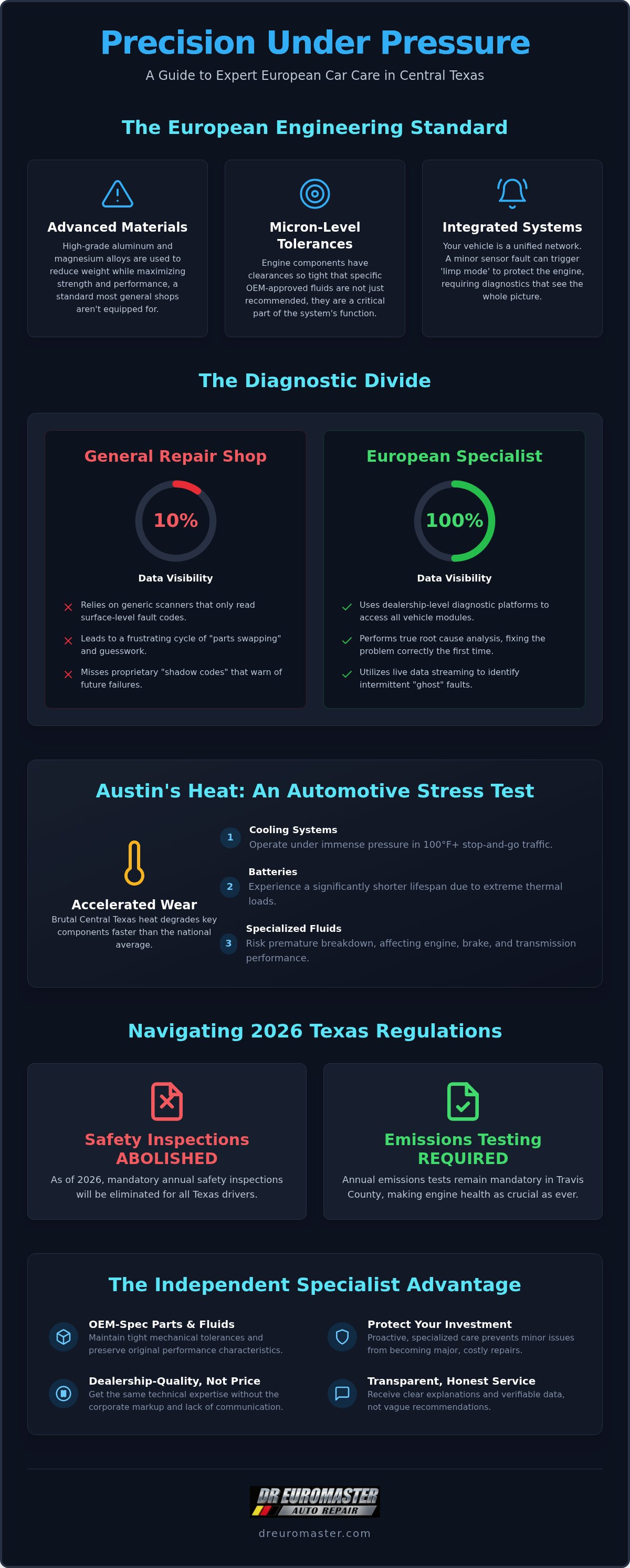
European vehicles aren't just transportation. They're finely tuned instruments. Brands like Audi and BMW utilize high-grade aluminum alloys and magnesium in their engine blocks to shed weight without sacrificing strength. This sophisticated approach to Automotive Engineering Principles prioritizes performance and efficiency over simple utility. When a machine is built with tolerances measured in microns, there's no room for "close enough" adjustments. This level of precision is exactly why specialized european car repair is mandatory for owners in Central Texas.
Precision matters. Quality is non-negotiable. These vehicles are essentially computers on wheels, where every mechanical action is monitored by a vast array of sensors. Routine maintenance schedules are dictated by these performance-oriented designs, requiring a disciplined approach to service that general shops often overlook. If you treat a high-performance European engine like a standard domestic vehicle, you risk compromising the very engineering that makes it exceptional.
Tight Tolerances and Performance Fluids
Tight clearances within the engine mean that oil isn't just a lubricant; it's a vital hydraulic fluid. It maintains variable valve timing and critical chain tension. If you use a generic synthetic oil with the wrong viscosity, you risk a drop in oil pressure or accelerated wear on internal components. Specialized European engines require oils that meet specific manufacturer approvals to ensure longevity.
European cooling systems are also built for high-speed endurance. They're designed for the sustained airflow of the Autobahn. In the stagnant 100°F heat of an Austin summer, these systems face immense pressure. Using OEM-grade fluids and components ensures that:
- Chemical properties remain stable under extreme thermal loads.
- Original handling characteristics are preserved through correct suspension damping.
- Braking systems maintain firm pedal feel even in stop-and-go traffic.
The Complexity of Integrated Vehicle Systems
Modern European cars function as a unified network. The engine control unit (ECU) communicates constantly with the transmission and braking systems to optimize traction, safety, and fuel delivery. A minor fault in an ABS sensor can trigger "limp mode," where the vehicle limits power to prevent mechanical damage. This sensitivity is a protective feature, but it requires advanced diagnostics to decode accurately. These sensors are incredibly precise. However, they're also sensitive to the dust and humidity typical of Central Texas. Professional european car repair focuses on verifying these data streams to ensure long-term reliability rather than just guessing at parts replacement.
Why Dealership-Level Diagnostics are Non-Negotiable
A "Check Engine" light is often the start of a frustrating guessing game at general repair shops. Most shops rely on basic scanners that only scratch the surface of your vehicle's data. True european car repair requires depth. It requires seeing into proprietary modules that generic tools simply cannot access. While Federal On-Board Diagnostic (OBD) requirements mandate a standardized port for emissions monitoring, they don't force manufacturers to share their most advanced engineering data. For Audi and BMW owners, this means a generic tool might show a "misfire" but won't explain the underlying cause.
Precision is the foundation of our process. We don't guess. We verify. By using the same diagnostic platforms found at the dealership, we can access deep-level software to see exactly how your engine is performing in real-time. This level of transparency protects your investment and ensures that we address the root cause of a problem the first time you visit.
Generic Scanners vs. Specialized Diagnostic Platforms
Generic scanners typically only view about 10% of the total fault data available in a modern European vehicle. They miss the "shadow codes" and background logs that often provide the first warning signs of a failing component. European cars utilize a CAN-bus (Controller Area Network) system, which functions like a high-speed nervous system where every module communicates simultaneously. Specialized tools act as a sophisticated translator for this complex language. Without them, identifying "intermittent electrical ghosts" is nearly impossible. We use live data streaming to monitor these signals under load, catching faults that only appear while you're actually driving on Austin roads.
Preventing Misdiagnosis and Unnecessary Repairs
Precision testing is the ultimate enemy of the "parts cannon" approach to repair. At many shops, if a fault code points to a major system like the transmission, the immediate recommendation is a total replacement. That's a massive, often unnecessary expense. A specialized diagnostic might reveal that a simple $50 sensor or a pinched wiring harness is the actual culprit.
Technician certification is critical when interpreting these complex reports. It's not just about reading a code; it's about understanding how integrated systems affect one another. If your car is acting up, our specialized vehicle diagnostics can pinpoint the specific failure point quickly. This methodical approach saves you money by ensuring you only pay for the repairs your car actually needs. We prioritize accuracy over speed to guarantee long-term reliability for every vehicle we service.
Independent Specialist vs. Dealership Service Departments
Choosing a service provider for your Audi or BMW shouldn't feel like a compromise. Many Austin owners assume the dealership is the only source for high-level technical care. This is a misconception. In reality, the "dealership tax" often funds massive showrooms and corporate overhead rather than better mechanical outcomes. A specialized independent shop provides a direct alternative. You get the same meticulous standards without the inflated invoice. Precision is our baseline. Transparency is our promise. When you choose a local expert for your european car repair, you're investing in the vehicle itself, not the dealership's architecture.
Personalized care makes a difference. At a dealership, you rarely speak to the person actually turning the wrenches. You're isolated by a service advisor whose primary goal is often upselling. We prefer a different approach. We believe in direct communication. You deserve to understand exactly what's happening under your hood. By working with seasoned technicians, you gain a partner who understands the history of your vehicle and prioritizes repairs based on safety and longevity rather than monthly quotas.
The Myth of the Dealership Monopoly
Federal law is on your side. The Magnuson-Moss Warranty Act ensures your factory warranty remains fully intact when you choose an independent specialist for maintenance. You aren't tethered to the dealership for oil changes or brake service. In fact, independent shops often retain high-tenured technicians who have moved away from the high-pressure, high-volume dealership environment. These experts prioritize SAE International diagnostic standards over quick turnarounds. This means your car receives more focused attention. We follow every manufacturer protocol to the letter. No shortcuts. No guesswork. Just disciplined mechanical work that keeps your warranty valid and your car performing perfectly.
Cost Efficiency Without Quality Compromise
Quality remains the priority. We source the exact same OEM parts used by the factory. There's no compromise on material integrity or fitment. Labor rates at independent Austin facilities are typically more transparent and reflect the actual time required for precision work. While dealerships might offer fancy loaner fleets and marble floors, those costs are eventually passed to you. We focus on the repair bill. We focus on the result. By specializing in Audi and BMW, we've streamlined our processes to offer faster turnaround times for major engine or transmission work. It's about efficiency. It's about respecting your time and your budget while delivering the premium european car repair your vehicle demands.
Maintenance Strategies for the Central Texas Climate
Austin’s environment is hostile to precision engineering. While high-performance Audi and BMW models are designed for the temperate climates of Europe, they face extreme stress in Central Texas. Sustained temperatures above 100°F create a thermal load that most vehicles aren't built to handle without specialized care. This environmental gap makes disciplined european car repair essential for anyone looking to maintain a high-value vehicle in the Hill Country. Heat isn't just an inconvenience. It's a mechanical catalyst for failure.
Precision requires protection. In Austin, that protection starts with your fluids and electrical systems. Heat accelerates chemical breakdown and physical wear at a rate that national maintenance schedules often ignore. We've seen how the local climate impacts even the most robust German engineering. By adjusting your service intervals to match the Texas reality, you ensure that your vehicle remains reliable year-round.
Cooling System Vulnerabilities in Austin
European manufacturers frequently utilize high-grade plastics for cooling expansion tanks, flanges, and hose connectors. These materials are efficient and lightweight, but they become brittle after repeated exposure to extreme heat cycles. In Austin, these components fail much faster than in cooler regions. A minor leak can quickly escalate into a catastrophic engine overheat during a commute on MoPac. We prioritize:
- Utilizing specialized coolant mixtures with higher boiling points for high-ambient temperatures.
- Conducting pressure tests on the cooling system before the summer peak in July.
- Inspecting plastic connectors and gaskets for signs of "weeping" or discoloration.
Brakes, Tires, and Suspension in Stop-and-Go Traffic
I-35 traffic patterns are brutal on performance braking systems. The constant stop-and-go movement creates immense friction heat that can lead to brake fade or warped rotors. Humidity is another silent threat. Brake fluid is hygroscopic, meaning it absorbs moisture from the air. Austin’s humidity can saturate your brake fluid, lowering its boiling point and compromising your stopping power. Regular fluid flushes are a non-negotiable part of european car repair in this region.
Road surfaces also play a role. Heat expands asphalt, creating uneven ruts and potholes that punish your steering and suspension. Proper wheel alignment is critical for maintaining original handling characteristics and preventing premature tire wear. Heat is also the primary killer of European car batteries, as it accelerates internal corrosion and fluid evaporation. Ensure your vehicle is prepared for the elements by booking your scheduled maintenance with our local specialists today. We focus on the details that keep you on the road, no matter the temperature.
The DR Euromaster Advantage: Trusted European Care
Since 2017, DR Euromaster has served as the premier, honest alternative to Austin dealerships. Our focus is narrow and deep. We specialize exclusively in Audi and BMW. This niche expertise allows us to provide a level of service that general shops simply cannot match. Every meticulous repair is performed with the understanding that your vehicle is a masterpiece of engineering. By choosing us for your european car repair, you're partnering with a team that values integrity and long-term relationships over quick transactions.
Transparency defines our process. We provide clear, honest advice without the high-pressure sales tactics common in the industry. There are no hidden fees. We communicate openly about what is actually wrong with your vehicle. For every critical repair, we utilize OEM or high-quality aftermarket parts to ensure your car remains as reliable as the day it left the factory. Precision is mandatory. Quality is our standard.
Meticulous Diagnostics and Engine Repair
We invest in the same dealership-quality diagnostic platforms used by factory technicians. This technology allows us to perform precise engine repair and transmission service without the guesswork. Our technicians are disciplined professionals who interpret complex data to find the root cause of any issue. This methodical approach is why we are the preferred choice for Austin car enthusiasts who demand perfection in their european car repair. We don't just fix problems. We verify the solution through rigorous testing to ensure your high-value asset is in capable, meticulous hands.
Serving the Austin Community and Beyond
Our commitment extends across Central Texas. We are proud to serve our neighbors in Cedar Park, Georgetown, and Round Rock with a grounded, local approachability. We understand the specific challenges of the Texas climate and design our scheduled maintenance plans to counteract the effects of local heat and dust. Every service we perform is backed by our robust 3-year/36,000-mile warranty. This provides you with absolute peace of mind for every mile ahead.
Reliability is built through consistent, expert care. Your high-performance vehicle deserves a specialist who respects the precision of its design. Don't settle for generic service when you can have dealership-quality work with a personal, local touch. Schedule your specialized European service today at DR Euromaster.
Protecting Your Performance Investment
Maintaining a high-performance Audi or BMW in Central Texas requires more than just standard upkeep. It's about a proactive strategy to combat the unique thermal stresses our climate places on cooling systems and electrical sensors. By prioritizing dealership-grade diagnostics and OEM components, you ensure your vehicle's intricate systems remain functional and efficient. Choosing a dedicated specialist for your european car repair is the most effective way to preserve the longevity of your engine while avoiding the high costs of a traditional dealership.
Since 2017, we've provided meticulous care for owners in Austin, Cedar Park, and Round Rock. Our team combines specialized Audi and BMW expertise with the industry's most advanced diagnostic equipment to deliver transparent, reliable results. You deserve a partner who understands the nuances of your vehicle and prioritizes its long-term health over quick transactions. Take the next step in securing your car's performance on the road. Book Your Precision European Service in Austin Today. Your vehicle is a masterpiece of engineering; we're here to help you keep it that way.
Frequently Asked Questions
Is it cheaper to repair a European car at an independent shop than a dealership?
Yes, independent specialists generally offer more competitive labor rates and transparent pricing models. Dealerships often have significantly higher overhead costs due to large facilities and corporate structures. We provide the same dealership-quality european car repair by sourcing OEM parts directly; this ensures you receive premium care without the unnecessary markup. This allows you to invest in the longevity of your vehicle rather than the dealership's architecture.
Can a general mechanic work on my Audi or BMW?
A general mechanic can perform basic tasks, but they often lack the proprietary diagnostic software required for deep-level module access. European vehicles function as integrated networks. Without specialized tools, a general shop might only see a fraction of the available fault data. This often leads to a "parts cannon" approach where components are replaced based on guesses rather than verified data. Specialized expertise is required to maintain precision engineering.
Will using an independent European repair shop void my car’s warranty?
No, your factory warranty remains fully valid when you choose a qualified independent shop for maintenance. The Magnuson-Moss Warranty Act prevents manufacturers from requiring you to use dealership services to maintain your coverage. As long as the shop follows manufacturer-specified service intervals and uses approved parts, your warranty is protected. We meticulously document every service to ensure your records are complete and your protection is absolute.
How often does a European car need an oil change in the Austin heat?
While some manufacturers suggest 10,000-mile intervals, the extreme Central Texas heat often requires more frequent service. High temperatures accelerate oil oxidation and chemical breakdown. We generally recommend an oil change every 5,000 to 7,500 miles for vehicles driven in Austin’s stop-and-go traffic. This disciplined approach prevents sludge buildup and protects the tight mechanical tolerances of your high-performance engine against premature wear and thermal degradation.
Why is my European car’s check engine light on but the car feels fine?
Modern European cars are equipped with hundreds of sensors that detect minute irregularities before they become physical symptoms. The light might indicate an emissions fault or a "shadow code" stored in the ECU. Even if the car feels normal, it may be operating in a restricted performance mode to prevent damage. Ignoring these early warnings often leads to more expensive european car repair needs later when the underlying issue finally cascades.
What are the most common repairs for BMWs in Central Texas?
Cooling system failures are the most frequent issue we see in the Austin area. BMW utilizes plastic components for expansion tanks and coolant flanges that become brittle and crack under extreme thermal stress. Oil filter housing gaskets and valve cover gaskets also tend to leak more frequently in hot climates. Additionally, heat is the primary cause of premature battery failure; most European batteries require replacement every three to four years in Texas.
Do I really need OEM parts for my European vehicle?
Yes, for all critical mechanical and electrical systems, OEM or high-quality aftermarket parts are essential. European engines are built with exceptionally tight tolerances that generic "will-fit" parts cannot always match. Using substandard components can lead to poor fitment, premature failure, or even damage to integrated systems. We prioritize parts that meet or exceed original factory specifications to ensure the long-term reliability and safety of your high-performance vehicle.
How long does a typical diagnostic check take at DR Euromaster?
A comprehensive diagnostic evaluation typically takes between one and two hours. This isn't just a simple code scan; it involves a detailed interrogation of all vehicle modules and a physical inspection by a certified technician. We take the time to verify the root cause of the issue rather than just reporting the symptoms. This methodical process ensures we provide you with an accurate, honest assessment of your car's specific mechanical needs.


